Maritime Security of India: The Coastal Security Challenges and Policy Options by Suresh R
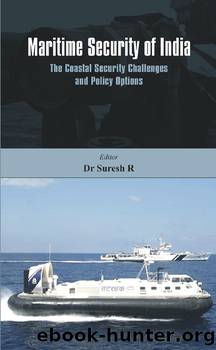
Author:Suresh R. [R., Suresh]
Language: eng
Format: epub
Tags: History & Theory, General, Maritime, India & South Asia, Political Science, Asia, History, Geopolitics, Law, Security (National & International)
ISBN: 9789384464226
Google: aAeqCQAAQBAJ
Goodreads: 34332897
Publisher: VIJ Books (India) Pty Ltd
Published: 2014-07-07T00:00:00+00:00
Chinas New Energy Strategy and the South China Sea Dispute
The world has entered a new era of more of dramatic transition, heralding a century of serious energy uncertainty. Major powers are moving from a position of relative energy independence to one of significant dependence on imports. Security for Asiaâs major energy sea-lanesârunning from the Hormuz Strait, into the Indian Ocean, through the Malacca Strait to Singapore, and into the South China Seaâcurrently lags behind the growing criticality of these waterways. Key economic powers in the region depend on sea-lane transport for the vast majority of their oil supplies, which in turn help to fuel their economic growth. The growing mismatch between the importance of the sea-lanes and the stress on and vulnerability of the system has contributed to rising energy insecurity in the region. The majority of the worldâs rising consumption of energy, and oil in particular, is occurring in Asia. Limited regional oil production means that Asia increasingly relies on imported oil, primarily from the Middle East. Close to 90 percent of the energy that China, Japan, and South Korea import must pass through the Southeast Asian sea-lanes (Storey, 2009a, p. 36). Continual access to these energy supplies is critical for sustained economic growth in Asia, which has been a source of stability in the region. In the last two decades, Asiaâs economic growth has diverged from that of other developing regions. Since the mid-1980s, economic growth in emerging Asia (including China and India) has been much stronger than elsewhere. Such growth has benefited from economic integration with the global economy. From the mid-1990s, China and India started to make their mark in the world economy. In 2009, according to World Bank, the Asia and Pacific region accounted for almost one-third of global GDP, while 54 percent of the regionâs GDP comes from just China and India.1 China has experienced rapid economic growth over past decades. In total economic size, China has quickly caught up with other large economies. In 2008, it overtook Germany to be the second largest economy in the world, and in 2010 it surpassed Japan to be the second largest economy. China has enjoyed rapid economic growth ever since it embarked on reform and opening up to the world in 1979, although the speed has varied from time to time. The surge forward was particularly impressive from the start of twenty-first century until the financial crisis, with the economy zipping along at a double-digit growth rate. In recent years, its economy has turned into a driving locomotive for the entire Asian continent. Undoubtedly, the country has become an important factor in global politics and economics with a tremendous impact on the political, social and economic development of all other states on our planet. Todayâs emerging new world order is unimaginable without China playing a crucial role in it. (Hauser and Kernic 2009).China has achieved remarkable economic growth during the past three decades, with Real Gross Domestic Product increasing at an average annual rate of over 10% between 1978 and 2008 (World Bank 2009).
Download
This site does not store any files on its server. We only index and link to content provided by other sites. Please contact the content providers to delete copyright contents if any and email us, we'll remove relevant links or contents immediately.
Spell It Out by David Crystal(36165)
Life for Me Ain't Been No Crystal Stair by Susan Sheehan(35858)
Cecilia; Or, Memoirs of an Heiress — Volume 1 by Fanny Burney(32640)
The Great Music City by Andrea Baker(32611)
Cecilia; Or, Memoirs of an Heiress — Volume 2 by Fanny Burney(32014)
Cecilia; Or, Memoirs of an Heiress — Volume 3 by Fanny Burney(31998)
Professional Troublemaker by Luvvie Ajayi Jones(29707)
The Secret History by Donna Tartt(19312)
We're Going to Need More Wine by Gabrielle Union(19111)
Twilight of the Idols With the Antichrist and Ecce Homo by Friedrich Nietzsche(18693)
All the Missing Girls by Megan Miranda(16338)
Cat's cradle by Kurt Vonnegut(15447)
Pimp by Iceberg Slim(14687)
For the Love of Europe by Rick Steves(14599)
Bombshells: Glamour Girls of a Lifetime by Sullivan Steve(14143)
Norse Mythology by Gaiman Neil(13460)
Talking to Strangers by Malcolm Gladwell(13448)
Fifty Shades Freed by E L James(13293)
The Social Justice Warrior Handbook by Lisa De Pasquale(12228)
